Duke Health Referring Physicians

Quick Case Study

Scoliosis Patient Was First to Receive Innovative Procedure in North Carolina

A 6-year-old female patient was referred to Duke by her local pediatrician after her mother noticed a possible abnormality in her spine. Duke pediatric orthopaedic surgeon Robert K. Lark, MD, MS, diagnosed idiopathic scoliosis. Lark recommended a brace as the first line of treatment, but the curvature of the patient’s spine did not improve.
 
The next standard, traditional treatment would have been a spinal fusion procedure, which can alleviate the curvature but significantly restricts the patient’s range of motion.

What innovative surgical solution did Dr. Lark offer to preserve flexibility in the patient’s spine?

The patient was presented with a novel surgical technique—vertebral body tethering as a corrective for scoliosis. She became the first patient in North Carolina to undergo the procedure in 2017.
 
In this procedure, the surgeon uses screws to attach a flexible polypropylene cord to the vertebrae on the outside of the curve. The tether is tightened so it pulls against the curve, which encourages vertebral growth on the inside of the curve and allows the maturing spine to grow out of the scoliosis.

The procedure is much less invasive and has a faster recovery time than spinal fusion. It avoids fusion’s limits on growth and motion, and leaves the spine free to move more naturally.
 
The tether remains in the body indefinitely. It may tear over time, but it is no longer needed once the patient reaches maturity.
 
To be candidates for tethering, patients need to have enough development remaining to grow out of the scoliosis, but not too much because the spine can grow into a problem in the opposite direction. The curvature needs to be large enough to benefit from surgery but not too great. “The tether is not strong enough to handle a super-big curve,” Lark says. “We typically don’t tether anything over 60 degrees. The sweet spot is a curve of 40 to 60 degrees.”
 
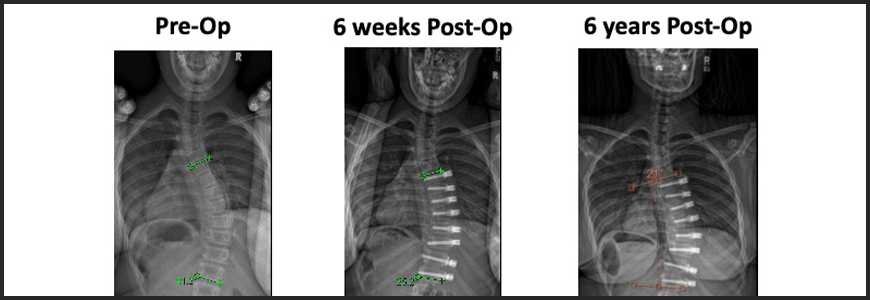
At 12 years old, with a curvature of just over 40 degrees, the patient was a good fit, Lark says. She was back in school less than a month after surgery and soon returned to her active life of playing volleyball. Five years post-surgery, she has a curve of 20 degrees and no physical limitations from her scoliosis or treatment. “If your curve stays under about 35 degrees, you can lead an active, healthy life,” Lark says.
Image
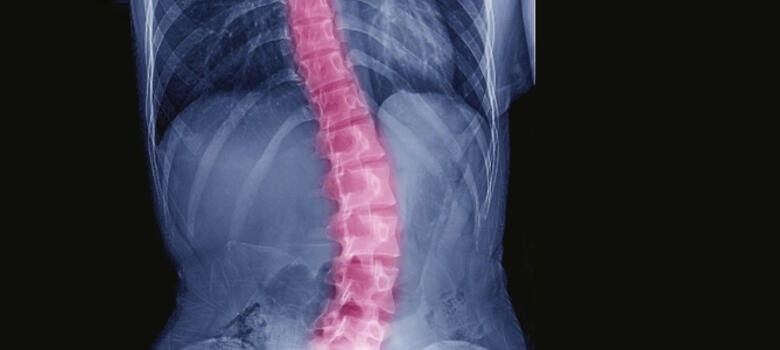
Xray of patient pre-op and post-op
Article

New Spine Surgeon Specializes in the Most Complex Cases

Duke Spine Center expands adult spinal deformity team

Image
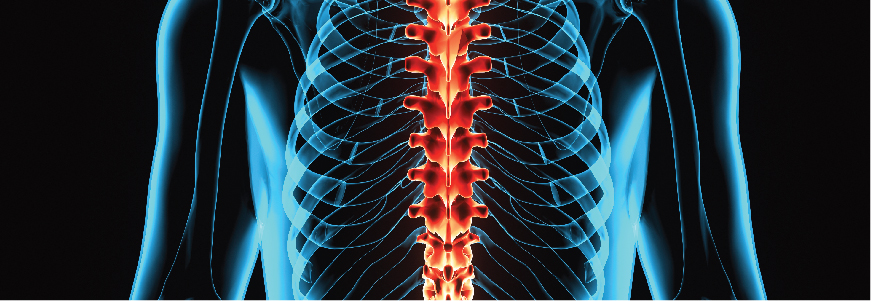
Illustration of spine

The Duke Spine Center, recognized as a high-volume and comprehensive care center for people with complex disorders, has expanded its team to include a new orthopaedic spine surgeon whose specialized training qualifies him to perform the most complicated procedures.

Brett Rocos, MD, BSc (Hons), MB, ChB, began his career as a general surgeon and went on to complete five specialized fellowships. He capped his training with two years at the University of Toronto in a program focused exclusively on the most technically demanding spine surgery cases.
 
“I always wanted to be the complete surgeon. I never wanted to have to turn someone away because I couldn’t address their condition,” says Rocos, who was recruited to Duke from the Royal London Hospital during an international recruitment process.
 
“I am experienced in seeing complex adult deformity patients as a result of injury or degeneration, as well as those who need revisions after previous surgery has failed for some reason,” Rocos says. “The patient may have had decompression surgery but their condition has progressed or led to a deformity that needs addressing, or had a previous fracture that is causing new problems. These patients need several disciplines involved in their care—including intensive care, anesthesia, dietitians, physiotherapists, and more—as opposed to patients with simple spine cases who can be in and out in a day.”

Refer a patient

To refer a patient, call 919-620-5168 or log in to Duke Medlink.

Rocos can address deformities using rods, plates, and screws in instrumented fusion procedures that can require 12-hour surgeries.
 
In addition to this patient care, he says his portfolio at Duke includes “driving forward research  looking at how we give patients with deformity the best care possible and improve their final results. The field has standards of care, but there are different approaches to achieving our goals. I’m interested in trying to understand which way is best for a given, individual patient. Duke is one of the few places in the world where we can answer that question. There are world leaders in every subspecialty here.”
 
Rocos welcomes referrals of any patients who may require spine surgery, but his training has focused on helping patients with recalcitrant problems. He specializes in the treatment of complex sacral, lumbar, thoracic, and cervical spinal disorders in adults using less invasive and open techniques. He has a special interest in the treatment of spinal deformity affecting the cervical or thoracolumbar spine and managing spinal trauma.

Article

Low Back Pain Management: The Case for Conservative Care

Duke’s Spine Health Program offers noninvasive resources, treatment options

Image
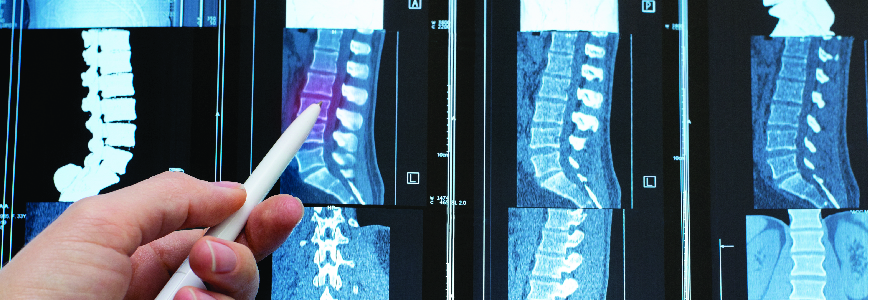
Scan of human spine

A new multidisciplinary collaborative—the Duke Spine Health Program—aims to enhance access to and improve the use of patient-centered, non-pharmacologic options commonly used by chiropractors and physical therapists as frontline treatments for low back and neck pain.

“Duke is committed to ensuring that patients with spine-related disorders receive the best care possible. Unfortunately, many available treatments—including opioids—are frequently associated with more harm than benefit to patients,” says Christine Goertz, DC, PhD, vice chair for implementation of spine health innovations in the Duke Department of Orthopaedic Surgery.

The program brings together chiropractors, physical therapists, acupuncturists, cognitive behavioral therapists, and other Duke clinicians to offer evidence-based conservative care—including spinal manipulation, exercise, massage, acupuncture, tai chi, and yoga—to treat patients with low back pain before considering medication.

Low back pain affects more than 31 million Americans at any given time and is a key source of medical costs and disability. It has many potential underlying causes, including muscle spasms or spinal stenosis, but there remain large gaps in clinical knowledge about why low back pain transitions from acute to chronic. And while many patients are referred to orthopaedic surgeons or neurosurgeons for spine surgery consultation, it is estimated that only a very small percentage of people with low back pain have an underlying condition that can be resolved through surgery, Goertz says.

“Often, patients who receive early conservative care have better outcomes and are less likely to develop chronic low back pain. In fact, the American College of Physicians recommends this approach for nonradicular low back pain before prescribing medication,” she adds. “Ensuring that each patient gets the right care from the right provider at the right time is not just a matter of convenience—it’s critically important to our patients’ long-term outcomes.” 

NIH grant awarded for quality improvement of low back pain management

Goertz and her Duke co-principal investigator Adam Goode DPT, PhD, were recently awarded an NIH grant for $958,353 to assess the capacity of Health Care Systems to move guideline-based care for low back pain to the forefront of the patient experience by rigorously evaluating a multidisciplinary conservative care model that utilizes doctors of chiropractic and physical therapists as the first point of contact for patients with low back pain. The results from this study will directly inform implementation and policy efforts to improve the quality of pain management for patients suffering from low back pain while simultaneously reducing opioid prescriptions, health care costs, and utilization of services.  

In the meantime, the Duke Spine Health Program is focused on providing training and tools for both patients and physicians about best practices for low back pain. These efforts are facilitated through a care redesign project and a low back pain performance measurement registry that is used to collect baseline data and quantify the impact of using conservative care before turning to treatment options that include imaging, injection, medication, or surgery. “What we’re seeing so far is that the majority of patients don’t receive conservative care at Duke before they see a primary care physician or a specialist for their low back pain,” notes Goertz. This is one of the things the Duke Spine Health Program is aiming to change.  

“There are many patients who have been living in debilitating pain for a long time and going from provider to provider to try to find a solution,” Goertz says. “At Duke, we offer a full range of treatment options for low back pain. As a result, we are able to provide patients with a coordinated multi-disciplinary care plan that best addresses their particular situation."

Provider talking points about conservative treatment for patients

Goertz recommends the following talking points for providers to consider when starting a conversation with patients regarding conservative treatment for low back pain.

  • The American College of Physicians recommends non-drug treatments commonly used by chiropractors and physical therapists before trying prescription medications.
  • Due to the self-resolving nature of low back pain, the vast majority of patients will get better with appropriate education and time.
  • Movement and exercise are a very important part of the healing process, and there are plenty of options for patients to choose from, depending on their situation and preferences.
  • Prescription medications are best suited for short-term use to manage moderate to severe breakthrough pain.
  • Imaging, surgery, or injections are not recommended until at least a six-week trial of conservative care is carried out. The majority of patients recover during this time period.

“Even if a patient has seen other DCs or DPTs in the past without success, I would encourage them to consider the Duke Spine Health Program,” Goertz adds. “Our providers are specialists in spine care delivery and best practices and may be able to help your patients.”

More information

Click on the links below for additional details about the Duke Spine Health Program:


Article

Advancing Spinal Imaging, Surgical Planning Capabilities

New system's full-body, weight-bearing images improve assessment for adult patients

Image
Xray of spine

A new 3D surgical planning platform—the first in North Carolina and one of only a few in the United States—enables Duke spine surgeons to more quickly and precisely assess musculoskeletal alignment while significantly minimizing radiation exposure for adult patients.

Traditionally, a surgeon combines multiple preoperative images to assess a patient’s spinal alignment and leg positioning. However, this advanced radiographic technology captures two full-body, weight-bearing images in less than 20 seconds with a radiation dose 50 times lower than conventional radiology, providing an accurate view of a patient’s spine and lower body in a natural standing position.

Since 2016, Duke has used the EOS system (EOS Imaging: Paris, France) for low-dose radiation spinal imaging, primarily with pediatric patients. The new system, EOSedge, was designed to provide better access to spine care imaging for adults, including those with high BMIs, and improve image quality. Duke spine surgeons can rotate and adjust the 3D parameters of the EOSedge images to better understand a patient’s spinal alignment in different positions and to optimize their pre- and post-surgical care plans.

Christopher I. Shaffrey, MD, chief of the Division of Spinal Surgery at Duke, says the ability to turn full-body imaging into 3D modeling improves the assessment of a patient’s spine alignment because it factors in the compensatory mechanisms that exist in the knees and hips.

“Achievement of alignment objectives has been shown to be the greatest predictor of successful long-term clinical outcomes,” Shaffrey says. “By having a better understanding of what the alignment should be, we’re able to personalize the specific correction and optimize care for patients with scoliosis, kyphosis, spina bifida, or other spinal pathologies that require revision surgery.”

Shaffrey notes that in addition to being used for spine care, this tool will serve as a long-term research platform for hip and knee replacement outcomes. In the future, it will also be used to optimize robotic-assisted surgeries, enabling smaller incisions due to the accuracy of preoperative planning.

“Our ability to better assess and inform the surgery with this technology helps us to best achieve and improve alignment and reduce complications for our patients,” Shaffrey says.

Article

Duke-Developed AI Tool Amplifies Surgical Expertise in Predicting Spine Outcomes

Q&A with Duke Spine Center surgeon

Image
Clinician next to model of human spine

A new machine learning tool that assesses surgical risk—dubbed Pythia— helps amplify the expertise of Duke providers in predicting postoperative outcomes for different types of high-risk surgeries. The tool was developed by the Duke Institute for Health Innovation.  

In this Q&A, Oren N. Gottfried, MD, a neurosurgeon at the Duke Spine Center, discusses the role of predictive analytics in personalized spine surgery and the ways in which Pythia helps providers and patients make better-informed health decisions.  

Q: How does Pythia use machine learning to help patients and physicians?  

Gottfried: This tool draws patient data directly from the electronic health record so we can have complex, real-time data at the point of care. It can assess a comprehensive set of data points from more than 100,000 patients treated at Duke without any effort on the part of the surgeon. As a clinician, I report to my patients about the possible outcomes of their spine surgery based on my experience, the available surgical literature, and the complex and multiple iterations the system runs for us, which in turn makes the patient more informed when they’re making clinical decisions.  

Q: How does Duke’s risk calculator improve on the National Surgical Quality Improvement Program (NSQIP) to predict patient outcomes for surgery?  

Gottfried: NSQIP’s predictive model is based on hundreds of thousands of patients throughout the country and enables a surgeon to assess statistically the predicted expected outcomes. However, that program requires manual data entry and does not include all of the details or codes associated with the surgery. Although NSQIP is a great tool, Pythia is an even better predictive tool because it is built and based specifically on our local patient population.  

Image
Oren N. Gottfried, MD
This type of tool is the future of spine surgery, and Duke is ahead of the curve in terms of how we look at and value these data. 
Oren N. Gottfried, MD

Q: How does Pythia fit into a patient’s assessment for spine surgery at Duke? 

Gottfried: The goal with Pythia is to use machine learning to identify spine patients who are at highest risk for postoperative complications. Again, the best predictive tool is based on your own patient population, and we have started using Pythia for spine and it is used for other surgical specialties. It is great that Pythia uses real-time data—without a clinician needing to enter it—that gives us predictions of how that patient would do compared to their peers with a similar condition or surgery. This type of tool is the future of spine surgery, and Duke is ahead of the curve in terms of how we look at and value these data.  

We use Pythia’s predictive analytics in two main ways:  

  • To help us understand where someone’s health could be optimized before surgery,  to help select patients for preoperative geriatric or anesthesia consultation and treatment, and to assess if the patient is better suited for a less invasive surgery or nonoperative treatment. 
  • As part of our weekly multidisciplinary indications conference for spine, where we decide which cases would benefit from surgery or other treatments. The tool is used for other conferences including with our quality group. 

By using this tool to assess preoperative optimization and postoperative outcomes, we’ve seen a very nice trend in improving our rates of readmissions and length of stay and other outcomes within our health system. It's because of these predictive analytic tools and modeling that we're able to better understand with the highest accuracy the severity of a patients’ illness.  

Q: What other metrics do you hope this machine learning tool can assess in the future?   

Gottfried: In the future, I’d like to see if we could predict patient satisfaction with surgery so that it’s not just an objective outcome. We’re working toward improving the patient’s overall life experience in addition to improving their functionality and other more objective aspects. We're also looking deeply into other metrics to improve, including return-to-work times, reduced time off from work, and quality of life, which can make a big difference in patient satisfaction rates.  

Article

To Operate or Not To Operate for Adult Symptomatic Lumbar Scoliosis?

NIH-funded intent-to-treat study finds surgery may be more cost-effective after five years

Image
Radiographs of spinal deformity

Although operative care for adult symptomatic lumbar scoliosis (ASLS) is more costly for patients than nonoperative modalities, a November 2019 study published in Spine found that it may be more cost-effective over time, representing a major shift in thinking around long-term treatment options for complex adult spinal deformity.

Christopher I. Shaffrey, MD, chief of Duke’s Spine Division and co-author of the study, says it was somewhat of a surprise that surgery compared as favorably as it did, even in the short term. “Traditionally, it’s been thought that patients with ASLS had few options because the potential risk for complications from the surgery was too high,” he says. “But this research has shown that there’s a chance that surgery may make a dramatic difference in a patient’s quality-adjusted life years.”

The intent-to-treat cost-effectiveness study analyzed randomized and observational data on patients with ASLS with at least five years of follow-up data from an NIH-sponsored study. Results indicated that operative care was above the threshold for cost-effectiveness in the first three years of the study but improved over time, becoming highly effective by years four and five, despite the potential need for revision surgery.

Patients who pursued nonoperative interventions—including physical therapy, epidural steroid injections, and neuroleptic medications—showed only incremental cost-effectiveness and slight improvement in quality of life over time, but in some cases, their condition continued to deteriorate. The study indicates that even if the cost of nonoperative care is low relative to operative care, it may not be of value if a patient’s prognosis does not improve.

According to the study, neither treatment is considered dominant, as the greater gains in quality-adjusted life years for those patients undergoing surgery come at a greater cost—including a longer recovery time and potential complications to their health. However, Shaffrey says the potential benefit of surgery has grown in the past decade while nonoperative care has remained static; the trend of operative care outcomes for patients with ASLS indicates that it may eventually be worth the cost, though more long-term follow-up research is needed.

“These surgical treatments are fairly durable at the five-year mark, but most people feel you need to have a 10-year durability of surgery to make the case that this is truly an effective treatment,” he says. “I think if we can continue to reduce the complications and improve the outcomes, it’s going to be an even more compelling argument for how these patients should be treated.” A follow-on study will analyze cost-effectiveness for both seven and 10 years post-surgery, Shaffrey adds.

Shaffrey says that surgical intervention for ASLS is on its way to dominance at Duke: “Our outcomes are 50% better and our complications are 50% less, despite operating on sicker and more debilitated patients,” he says. “We’ve also improved the way we’ve treated and managed these patients over time and are doing surgery better and safer with better results than we did 10 years ago.”

Duke is also involved in the second International Spine Study Group Foundation’s complex adult deformity surgery study, which is looking at ways to further reduce complications and improve outcomes in this patient population. “We’re continuing to do active clinical research to improve outcomes and improve safety with the surgeries we’re doing,” Shaffrey says. “Duke is going to be on the cutting edge of all of the major innovations occurring in the field of spinal surgery.”

Article

Robotic-Assisted Technique Makes Spinal Surgery Minimally Invasive

New procedure eased mind of patient who feared spinal fusion

Image
x-ray of hip joint

A man in his 60s had few remaining options after a long history of lumbar spine degenerative disease. He experienced little relief from his back and leg pain after conservative therapies including physical therapy and methyl-prednisone injections. But he feared a spinal fusion would interfere with an active lifestyle that included motorcycle riding.

When he presented to Duke neurosurgeon Anna R. Terry, MD, MPH, his condition had progressed to lumbar stenosis and degenerative scoliosis. After reviewing the options with the patient, Terry performed an L2 to L5 laminectomy that provided the patient brief relief and enabled him to return to his usual activities after physical therapy. However,  just six months later, the patient’s pain had recurred and his had posture worsened; imaging studies revealed that his scoliosis curve had increased, affecting his nerves..

To correct the curvature and decompress the nerves, Terry recommended spinal fusion and explained that the new technology combining advanced imaging and robotic guidance permits minimally invasive surgery that improves outcomes and shortens recovery times. Duke is one of only a few centers in the region offering spine surgery using the new ExcelsiusGPS Robotic Navigation system (Globus Medical Inc., Audubon, PA).

Pre-operative imaging studies, such as a CT scan, are merged with real-time images on the operating table to enable the surgeon to plan incisions and trajectories and precisely place hardware. A reference frame is attached to the patient (typically to the iliac crest) and the C-arm. A robotic arm holds and helps guide the instruments through small incisions, avoiding the need for a large midline incision through the musculature.

This patient’s fusion from L2 to L5 “involved a dual approach,” Terry says. “The first step was to use the extreme lateral approach to remove the affected disks, open up the space, and insert bone grafts to stabilize the spine and indirectly decompress the affected nerves. The second stage was inserting posterior instrumentation to stabilize the spine.”

“The advantages of a minimally invasive approach are less tissue dissection; smaller incisions, which mean less chance of infection; a shorter hospital stay; and better pain control for the patient,” Terry says.

Terry says that because the fusion needed to extend from L2 to L5, this patient was a good candidate for the use of robotic navigation to assist in placing the screws, which makes that part of the procedure more accurate and efficient.

“We can navigate in the ideal position for creating the entry points and place the screws along that same trajectory with minimal error,” Terry says. “We don’t have to take multiple passes through the tissue to get the right pathway because it is done through software navigation.”

Already experienced with imaging and robotic-assisted navigation in cranial neurosurgery, Terry sought training on the new system as soon as it became available at Duke. Terry and colleagues Phillip Horne, MD, PhD, spine surgeon, and Peter Grossi, MD, neurosurgeon, have performed several of the minimally invasive spine surgeries using the technology.

“I have been using the technology regularly and have treated many patients using robotic-guided screw placement through various modalities,” Horne says.

Despite the initial concerns of Terry’s patient about undergoing a spinal fusion, he “is several months out from surgery and doing really well,” Terry says. “He is now able to stand up straight, with no leg pain and minimal back pain. He has already been on several long bike rides and is gradually returning to his active lifestyle.”