
Although they’re one of the most common congenital heart defects, even large atrial septal defects (ASD) may not be detected until adulthood. Untreated ASDs can lead to pulmonary hypertension, arrhythmias, heart failure, or stroke. “If an ASD is detected, the patient should be evaluated for possible closure,” says congenital cardiothoracic surgeon Tracy Geoffrion, MD, MPH, director of adult congenital heart surgery at Duke Health.
“Surgery is indicated for patients with symptoms or hemodynamically significant overflow of the pulmonary arteries causing heart dilation,” she continues. “Our Adult Congenital Heart Disease [(ACHD)] team can help guide decision-making about whether ASD closure is needed.”
Once it is determined that a patient needs surgery, Duke has a team of specialized heart surgeons to evaluate patients with ASDs for a minimally invasive approach. “The patient population for ASDs is unique in robotic heart surgery,” says adult heart surgeon Brittany Anne Zwischenberger, MD, who collaborates with Geoffrion and Douglas Overbey, MD, MPH, on robotic surgeries for congenital heart conditions. “They tend to be significantly younger than other procedures’ populations.”
Advantages of minimally invasive ASD repair
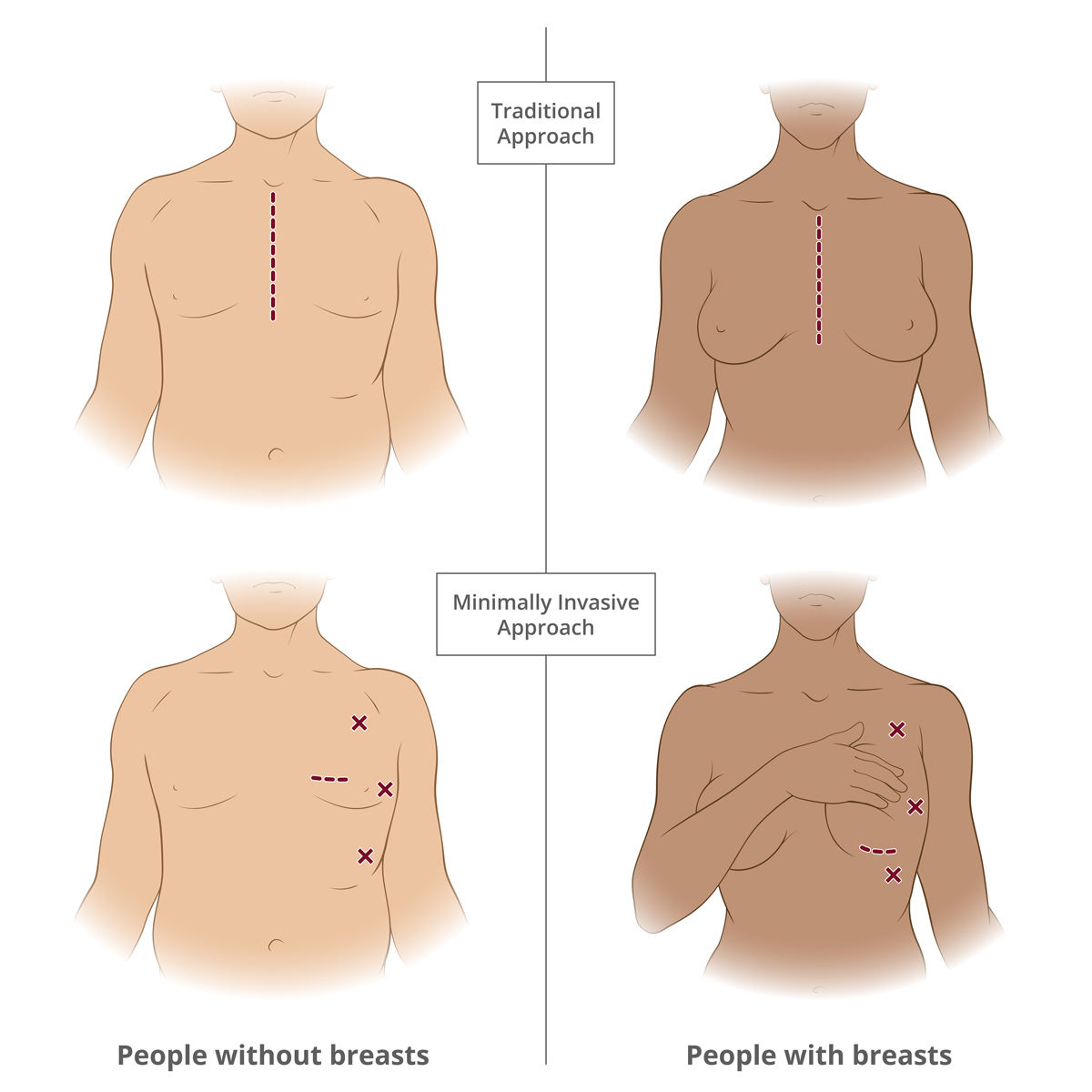 Minimally invasive techniques, including mini-thoracotomy and robotic surgery, make a surgery that once required sternotomy more manageable for patients. Using smaller incisions, these approaches spare the sternum, allowing patients to return to work or more strenuous activities after two weeks rather than six.
Minimally invasive surgery also reduces the risk of complications related to the sternal wound, including mediastinitis. “Patients have a reduced need for blood transfusions when we approach between the ribs,” says Zwischenberger.
When compared to mini thoracotomy, the robotic approach offers surgeons better mobility, visualization, and precision. “Robotic ASD surgery is not easier to perform than a sternotomy,” Geoffrion says. “We offer it because of the benefit to the patients in faster recovery.”
The American College of Cardiology (ACC) has updated its guidelines for the care of adult congenital heart disease. Tracy Geoffrion, MD, MPH, served among the authors of the updated guidelines published in the ACC’s journal and Circulation.
Limitations of minimally invasive ASD repair
The success rate for minimally invasive ASD repair is similar to a sternotomy approach. However, robotic cardiac surgery takes longer to perform and is associated with a longer bypass time, which may reduce cardiac contractility after the procedure. This is almost always mild and improves quickly, but for patients whose cardiac function isn’t good at baseline, this approach is not ideal.
Robotic surgery is not appropriate for patients with severe heart dysfunction. Patients with additional congenital abnormalities may require further operations that are not feasible with the robot, such as an intervention on the aortic valve.
Small patients, such as children and petite adults, may not have adequate chest size for robotic instruments. On the other end of the spectrum, severe obesity can make robotic surgery more challenging “but is not a definite contraindication,” Geoffrion notes.
“Our team can help determine the most appropriate surgical approach for each individual patient,” Geoffrion says.

Congenital heart care at Duke
Duke leads in research and clinical care for both pediatric and adult congenital heart conditions, with a robust cardiac surgery program. As a high-volume center, care pathways for heart patients are well defined, allowing excellent care and collaboration among cardiologists, cardiac surgeons, the catheter lab, the cardiac intensive care unit, and other specialties.
“Our comprehensive program includes ACHD cardiology and interventionalists,” Geoffrion says. “Additionally, from a surgical perspective we leverage the experience of other cardiac surgeons in the practice to achieve the best possible outcomes. If I have a patient with an ASD associated with another heart condition, I will operate with one of my adult partners, addressing everything at one time to optimize results and the patient experience.”
Geoffrion says the group hopes to continue expanding the list of diagnoses for which they will offer robotic surgery. “We’re working toward offering a robotic approach to partial anomalous pulmonary venous return (PAPVR),” Zwischenberger adds. “It requires complex surgical reconstruction of the pulmonary venous drainage with the robot.”
The team also performs surgery to relieve the symptoms of vascular rings. “We’re always searching for ways to provide an easier recovery after heart surgery,” Geoffrion concludes.