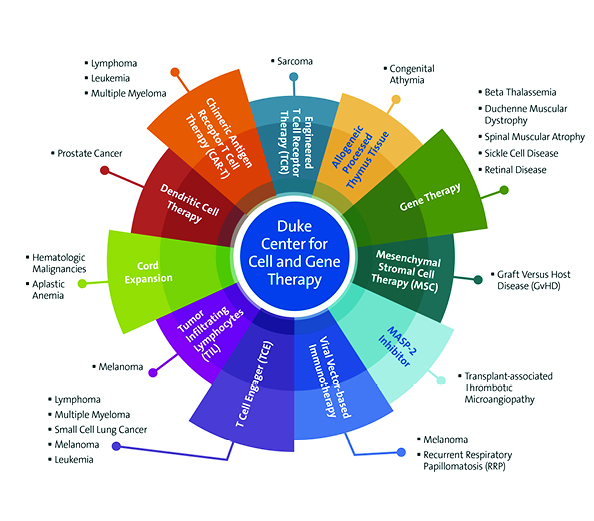
Duke Health is committed to remaining at the forefront of cell and gene therapy developments. As such, the health system is expanding patient and provider access to cell and gene therapies and aims to accelerate their adoption for current and future Duke patients. This includes dedicating significant resources to strengthening the operational, financial, and logistical infrastructure required to deliver cell and gene therapies for more diseases and conditions beyond cancer. The program is structured around four pillars (clinical care, research, education, and quality) to expand access to novel therapies, improve outcomes through coordinated, high-quality care, and accelerate translational discoveries.
“We are proud to have built one of the world’s most comprehensive cell and gene therapy programs. We want to ensure that groundbreaking science and medicine translates into real patient access locally, regionally and nationally,” says Greg Pauly, president of Duke University Hospital and group president of Acute Care Services for Duke University Health System.
Duke’s leadership in cellular and gene therapies reflects years of innovation that have led to strong patient outcomes and experiences. Duke is one of just four hospital systems in North Carolina accredited by the Foundation for Accreditation for Cellular Therapy, and it is the only program in the state to offer all FDA-approved cell and gene therapy products.
To refer a patient or discuss a case, call 919-684-7115, fax 919-385-9139, or email CARTatDUKE@duke.edu.
Rapid growth of cellular therapies
Duke Health’s cell and gene therapy offering includes more than 20 physician specialists who treat more than 100 patients each year. That number is expected to grow as Duke expands the applications of all three categories of cell therapies currently approved by the FDA. Integrated clinical expertise across specialties, including neurology, ophthalmology and otolaryngology for standard-of-care treatments, as well as rheumatology, endocrinology, surgery and dermatology for emerging therapies, will help advance the potential of novel therapies to treat more diseases and conditions.
“We have a lot of research now starting to suggest that cellular therapies can be used not just for cancer but for all kinds of diseases. Our efforts will better centralize our operations to deliver these treatments safely and effectively with our vast network of colleagues in other specialties,” says Chenyu Lin, MD, medical director and co-chair of the Cell and Gene Therapy Program.
Continued leadership in cell and gene therapy
Duke Health was the first in the region to offer FDA-approved cellular therapies for solid tumors, including tumor-infiltrating lymphocyte (TIL) therapy for melanoma and T-cell receptor (TCR) therapy for synovial sarcoma. For children, Duke Health is one of the few health systems in the country to offer mesenchymal stromal cell (MSC) therapy for acute graft-versus-host disease, and it is one of few sites in North Carolina to offer gene therapy for sickle cell disease and beta thalassemia.
Duke Health is well positioned to expand cell therapy treatments like these for more patients. It operates under an FDA-approved Risk Evaluation and Mitigation Strategy program and has established protocols designed to support efficient, timely treatment. Dedicated care coordinators and highly skilled nurses provide ongoing support and serve as key resources for patients, caregivers, and referring providers.
Clinical trials expand treatment options in cancer care
Duke has led clinical trials for emerging cellular and gene therapies for more than a decade. The program currently has 12 active clinical trials examining investigational cellular therapies and supportive care for cancer patients, with several additional studies evaluating novel cell therapies for nonmalignant diseases.
“We look at the gaps in current commercially available products and identify which patients are ineligible for these therapies. Then we determine how we can best fill these patients’ needs by expanding our research portfolio,” says Lin.
He adds, “These clinical trials offer opportunities for patients to try treatments that are not available on the market, therapies that might be more effective or, for some patients, we’re giving them options when a treatment isn’t available otherwise.”