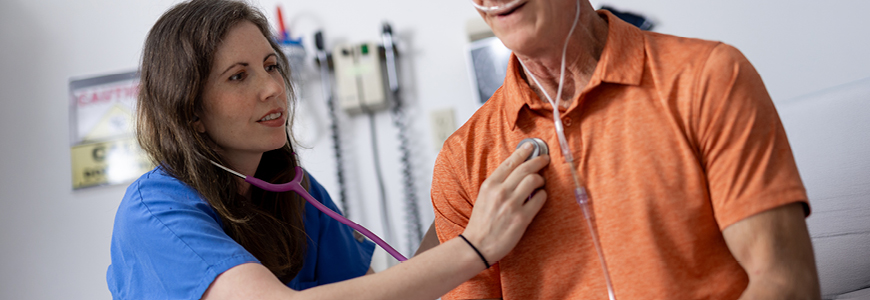
When a 61-year-old woman with sarcoidosis faced hospitalizations and decreasing lung function despite maximal medical therapy, she was referred to Duke Lung Transplant Program to be evaluated. Transplant pulmonologist Laurie D. Snyder, MD, MHS, associate medical director of the program, met with the patient, and the lung transplant team determined that the patient was a good candidate for transplant, but her antibody levels meant that only one donor in 10 had the potential to be a match.
“The patient had a fairly extensive history, including some prior history of cancer as well as high antibody levels during our initial testing,” says transplant pulmonologist Katie Young, MD. “Thankfully, her local pulmonologist referred her early for transplant and this allowed our team to work through and optimize her medical conditions and allow us time to find a donor match for her.”
Young notes that at large lung transplant centers like Duke, the program can work with patients with complex medical histories or unique challenges to become transplant candidates where traditionally the patient may have been turned away at other transplant programs. “Early referral allows us the luxury of time to follow patients and improve other aspects of their health or situation while closely following their lung disease alongside their local provider with the goal of working toward transplant if the patient’s disease progresses," Young says. “If you’re not sure, just refer.”
How did the Duke team find a donor for this patient?
Two newer advances enabled the patient’s transplant. After the initial period of medical evaluation, multidisciplinary patient education, and pulmonary rehabilitation onsite at Duke, the patient was able to join the stable waiting from home pathway, returning to her home and continuing pulmonary rehab virtually with careful monitoring from the Duke transplant team.
“If we can decrease our patients’ travel costs through innovation, and they can have appointments and pulmonary rehab in the comfort of their own homes, we’re happy to work with our patients who are amazing and very invested,” says Young. “It’s really been transformative for our patients.”
Ex vivo perfusion, the second innovation, has helped to expand the donor pool. Donor organs are perfused after explantation, allowing more time for lung transplant surgeons to evaluate organs that might have otherwise been discarded.
Newer technologies have also allowed for lung optimization during this time. “Duke has one of the shortest waitlists in the country for lung transplant. A major reason behind this is our surgeons who work tirelessly to harness these new technologies and are continuously innovating to locate potential donors for our patients and give them the best possible outcome,” Young says.
Eight months after the patient’s initial evaluation, she received a lung transplant. Within three months, she was already in the normal range for lung function. “I think I’m doing so well right now because the Duke team prepared me so thoroughly,” the patient says.
“Early referral is paramount,” Young concludes. “The more time we have to work on modifiable factors and educate patients about transplant, the more successful we are, the better the outcomes. If there’s ever a question, we’re happy to see these patients.”
Refer a patient to Duke Transplant or learn more about lung transplant (PDF).