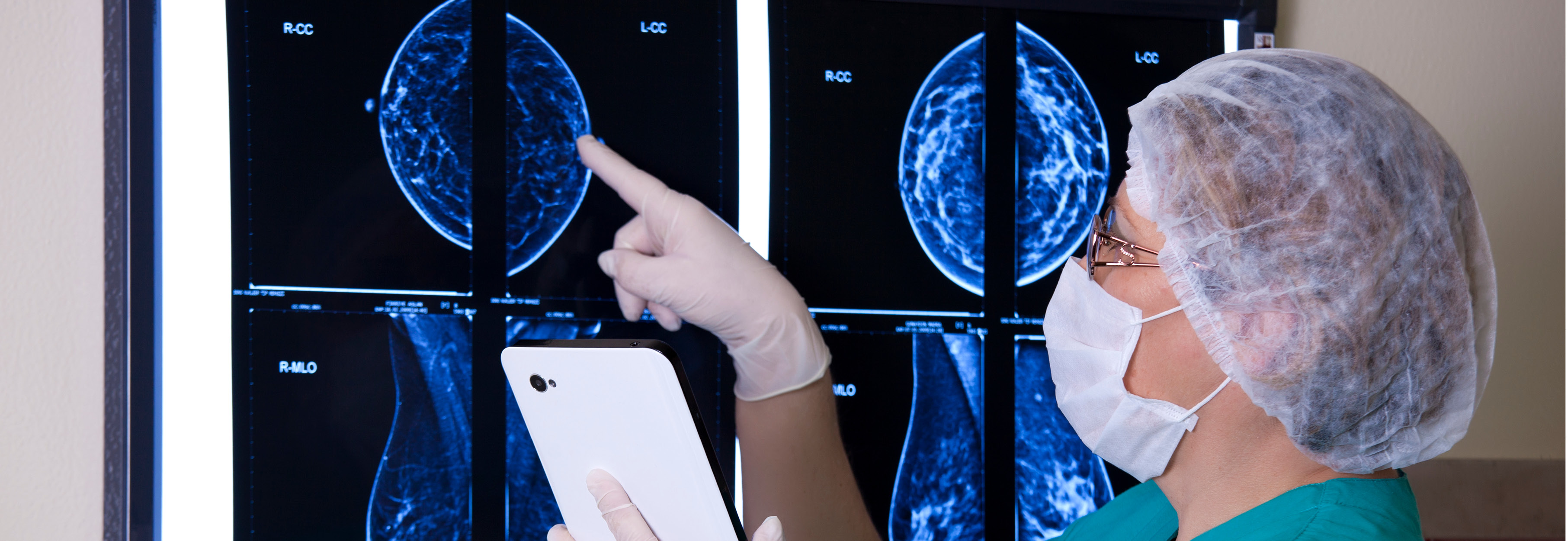
Although phyllodes tumors are rare, Duke treats a high volume of patients, averaging about two each week from across the country. Patients travel to Duke to receive care from experts such as surgical oncologist Laura H. Rosenberger, MD, who has supported the expansion of care for phyllodes tumors at Duke and advanced the field by contributing to diagnostic classifications that led to new pathologic reporting standards and national and international guidelines.
“The team’s collective focus on this rare tumor — spanning surgery, medical oncology, radiation oncology, plastic surgery, thoracic surgery, and genetic counseling — makes Duke a true destination program,” Rosenberger says. “I am fortunate to work closely with a truly outstanding group of clinicians in this program who not only have interest and expertise in this rare tumor, but also deliver exceptional care.
Call 866-385-3123 (1-866-DUKE-123) to refer a patient for a phyllodes tumor consultation, email OncologyReferral@Duke.edu, or fax 919-613-2316.
Expanding diagnostic and treatment guidelines
Thorough pathologic assessment and reporting are critical to properly diagnosing and accurately classifying phyllodes tumors. Clinically, these tumors can be misidentified as the common cellular fibroadenomas, which more frequently affect teenagers and women in their 20s.
“Phyllodes tumors are more common among patients in their 40s and often present as a large, rapidly growing breast mass, usually measuring larger than 3 to 5 cm. In this context, core-needle biopsy results showing a fibroadenoma or fibroepithelial lesion should raise suspicion for a phyllodes tumor and prompt a referral to a specialist,” Rosenberger says.
Over the past five years, Duke has led a multicenter collaboration with about 10 other institutions to expand the understanding of this rare tumor. One impactful collaborative study reviewed 500 pathology reports to evaluate the histologic features included in pathology reports. Duke worked with the College of American Pathologists and co-authored a new standardized reporting template that requires documentation of all individual histologic features. This has now been incorporated nationwide and is in routine use today.
“This was a giant leap forward to study these tumors. It enables meaningful cross-institutional tumor comparisons, previously not possible,” Rosenberger says. “Other national and international clinical care guidelines are also expanding, improving accurate and timely care for patients. Most notably, malignant phyllodes have been added to germline genetic testing guidelines and the National Comprehensive Cancer Network Soft Tissue Sarcoma clinical practice guidelines.” This also includes the World Health Organization’s imminent reclassification of some high-risk borderline phyllodes tumors as malignant.
Practice-changing tumor registry
The team at Duke has created a unique prospective tumor registry and biorepository that currently contains 220 patients being followed prospectively, with approximately a third having associated tumor and plasma. The program originated from a commitment to gather more granular data for study, identify pathologic and treatment factors that may impact recurrence events, and improve care for this rare tumor.
Using banked tumor and plasma from the biorepository, Duke recently conducted a pilot study that found circulating tumor DNA (ctDNA) in every patient with known metastatic disease. This suggests that ctDNA could serve as a future biomarker for predicting recurrence or metastatic progression, as it has in other solid tumors. Duke is now preparing a prospective ctDNA trial designed to detect conversion from negative to positive following surgical resection and enable early intervention.
While knowledge of somatic genomic alterations remains limited, Duke is involved in an active FDA-sponsored multi-institutional trial with Memorial Sloan Kettering and Mass General Brigham. The trial is sequencing 150 borderline and malignant phyllodes tumors to identify gene alterations and determine which are associated with local recurrence or metastasis. Along with abstracted clinical, pathologic, and treatment factors, they will create a nomogram with Duke biostatistician Samantha Thomas, MS, as a tool to predict recurrence events.
Early referral is key
Providers are encouraged to refer patients to Duke as early as possible, ideally at the time of an enlarging mass, or after core needle biopsy results raise suspicion of a phyllodes tumor and while the tumor is still intact. Duke will schedule new patients quickly and is equipped to support patients traveling from anywhere in the United States.
Duke’s multidisciplinary team has expertise in treating all types and stages of phyllodes tumors, including benign, borderline, and malignant tumors. This is especially important for recurrent tumors, which may require complex operations involving the chest wall or distant metastatic sites, requiring collaboration between reconstructive plastic microsurgeons and thoracic oncology surgeons to achieve chest wall reconstruction.